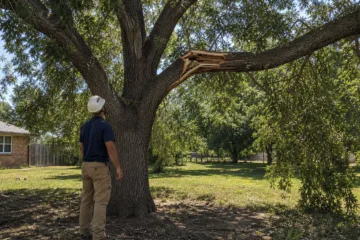
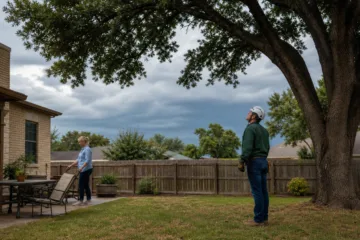
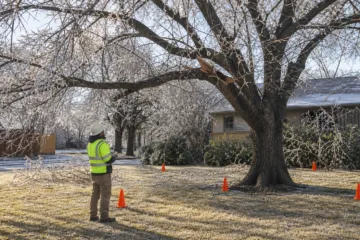
Document storm damage only from a safe location. Wide photos, close views taken without entering the drop zone, dates, weather notes, affected structures, and professional estimates create a clearer record. Contact the insurer for policy-specific instructions; tree-care contractors do not decide coverage.
This guide is for property owners creating a clear record after a storm. It explains what to observe, what to avoid, and how to prepare for a useful on-site conversation. Conditions vary by tree, species, site, and weather, so the guidance supports—not replaces—a property-specific assessment.
Safety comes before photographs
Do not walk under hanging limbs or approach downed conductors to get a better angle. Use zoom from outside the exclusion area. Call emergency services or the utility for active hazards.
Capture context and detail
Take wide images showing the whole tree and its relationship to structures, then closer views of breaks, roots, and impact areas where safe. Photograph damaged property before moving debris unless movement is required for safety.
Keep a simple event log
Record the date and approximate time, observed conditions, calls made, temporary measures, contractor visits, and receipts. Preserve original image files rather than only screenshots or compressed messages.
Request a specific work description
An estimate should identify the tree, work area, removal or pruning scope, debris handling, access constraints, and any urgent stabilization. Share it with the insurer and ask what documentation the policy requires.
How to prepare for an estimate
Mark the tree or landscape area, measure gates and access routes, secure pets, move vehicles when safe, and decide whether debris should be hauled, chipped, or left in an agreed form. Review the site’s emergency tree service information before the visit, then request a free quote with the objective and access notes.
Which primary sources support this guidance?
The following primary or standards-based resources explain the underlying safety, soil, material, or installation principles. Local codes and a site-specific assessment control the final scope.
Related local service: Abilene Tree Removal Process.
What are the main takeaways about document storm-damaged trees in Abilene?
| Observation | What to record | Practical response |
|---|---|---|
| Core finding | Document storm damage only from a safe location. Wide photos, close views taken without entering the drop zone, dates, weather notes, affected structures, and professional estimates create a clearer record. Contact the insurer for policy-specific instructions; tree-care contractors do not decide coverage. | Photograph and compare over time; request an assessment if the condition is active or creates a safety risk. |
| Decision scope | Use a specific objective and preserve healthy growth that is not part of the problem. | Photograph and compare over time; request an assessment if the condition is active or creates a safety risk. |
| Safety condition | Keep people away from overhead hazards, unstable wood, and conductors. | Photograph and compare over time; request an assessment if the condition is active or creates a safety risk. |
| Site information | Document access, nearby targets, utilities, and debris preferences. | Photograph and compare over time; request an assessment if the condition is active or creates a safety risk. |
| Assessment threshold | Choose on-site assessment when the condition or safe work method is uncertain. | Photograph and compare over time; request an assessment if the condition is active or creates a safety risk. |
Frequently Asked Questions
What is the first step for storm-damage documentation in Abilene, Texas?
Start with a ground-level inspection and define the exact objective. Document the tree or landscape area, nearby structures and access. Keep people away from hanging branches, downed lines, or unstable wood, then arrange an on-site assessment when the work is beyond safe hand-tool reach.
When should Abilene property owners call a professional about storm-damage documentation?
Call when the work involves large or elevated branches, a tree near structures or utilities, storm damage, uncertainty about tree condition, or equipment beyond basic ground tools. A professional can evaluate the site and write a scope tied to the actual objective.
Can storm-damage documentation be handled as a DIY project in Abilene?
Only small, reachable tasks with no overhead hazard may be reasonable for a prepared property owner. Do not climb, work from an unstable ladder, cut tensioned wood, approach energized lines, or stand under damaged branches. Larger work needs trained crews and a controlled work zone.
How does West Texas weather affect storm-damage documentation?
Heat, drought, strong winds, rapid weather changes, and occasional ice can affect tree condition and recovery. Preserve healthy foliage, avoid unnecessary heavy cutting during stress, and adjust timing and aftercare to the plant and current conditions.
How can I request an estimate for storm-damage documentation near Abilene?
Use Abilene Tree Trimming’s contact or free-quote page and include photos, the property location, access notes, nearby targets, and the result you need. An on-site review is the best way to confirm the appropriate service and scope.
Get a clear local scope
If this issue is affecting your Abilene-area property, contact the local team or call 325-480-8891. Describe the tree or landscape area, what it is affecting, and any access limitations. Abilene Tree Trimming can review the site and provide a no-obligation estimate for the appropriate service.